Chablis, Shablazzle, Hasenfeffer Incorporated
My parents cracked open a few bottles of wine on Turkey Day, and this is the first I’ll mention. Personally, I’d never had Chablis before, but I’ve had plenty of Chardonnay. I like some Chardonnay, and do not like others. Personally, I’m a fan of big, over-the-top, butter-and-oak Napa Chardonnay.
This couldn’t have been further from that.
Which isn’t to say I hated it, but it really wasn’t for me. The color in the glass is very pretty, a light yellow straw color that turns almost completely clear in certain light. It actually looked very similar in color to the stick of butter on the serving dish in front of me.
On the nose was skunkiness that in no way smelled like “bad” or “turned” wine. It was skunky in a good way, if that makes sense. A bit of a mineral/stone/earth note, along with a hint of sour apple, like a Granny Smith.
None of the skunkiness followed onto the palate, but the apple did. The sour apple was followed by a kind of sweet citrus, almost grapefruit, and the finish was punctuated with a nuttiness that I took for an almond character.
In general, the wine was dry and acidic, so if that’s your thing, you may well love this wine. For me, however, it’s just not what I choose to drink, and it’s not something I could get super-excited about. The flavors were a bit flat for me, and the wine was a bit sour all-around.
Verdict: C+
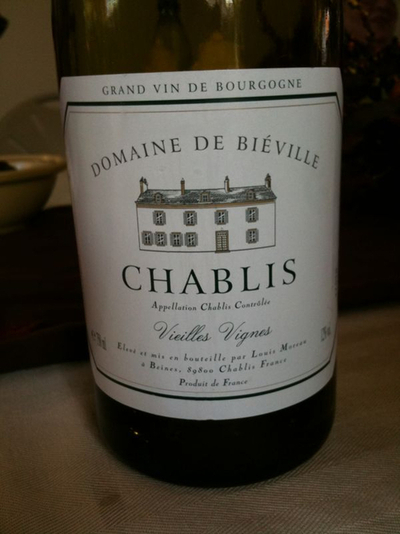
2007 Domaine de Bieville Chablis
Recently, I mentioned wanting to institute a change. I think I figured out how I want that change to happen.
Instead of the Parkeresque 100 point system (which, really, is a 70-100 point system, have you ever seen any wine get under 70 points?) I’m going to use a tried-and-true system that, at the very least, should make perfect sense to any Americans who went through just about any time of schooling in their lives. The A-through-F letter grades.
Here’s a little key I’ll use to describe what I mean by each level of grading. While you might be tempted to translate these letter grades into their Parkerite score (90-100 is an A, 80-89 a B), it doesn’t quite work that way.
- A+ : This is fan-friggin-tastic wine and you need to, need to be drinking it. Whenever possible. My highest possible recommendation.
- A: Excellent wine. I really loved it and am definitely recommending it. Go track it down.
- A-: Loved it, recommending it without hesitation. Something kept it from the A/A+ realm but it’s still fantastic.
- B+: Really good. Recommended. Thoroughly enjoyable.
- B: A good wine. Recommended. I’m basically saying go for it if you like the varietal or if it’s exceptionally priced. You would never be embarrassed to serve it to company.
- B-: Decent wine. Probably not really for special occasions, but still basically a recommendation. I’m not excited about this wine, though.
- C+: Something about this wine turns me off. Something’s missing. Recommended only for fans of the producer, varietal, or region.
- C: The wine has real flaws. I can’t recommend it.
- C-: More flaws, less reason to pick up the wine. The fact is there is better wine out there, regardless of this wine’s price point.
- D+: Probably avoid.
- D: Avoid.
- D-: Avoid even if it’s being served to you by a close friend or family member.
- F: Avoid like the plague.
That should pretty much sum it up. I’m going to go back and add letter grades to all my previous reviews, and moving forward, each wine’s verdict will feature the letter grade.
I’m hoping this allows for a more general ability for me to recommend (or not) wine, without looking like I really think there’s a pinpoint precision to all this. There isn’t. Not even for Robert Parker.